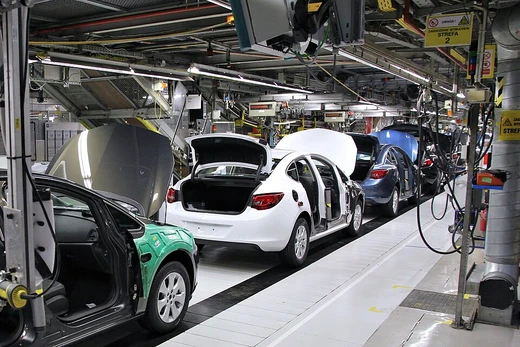
Ford Motor Company
American automaker that pioneered mass production via assembly lines.

via Wikipedia: Automotive industry in Canada · see source
The Ford Motor Company (commonly known as Ford, sometimes abbreviated as FoMoCo) is an American multinational automobile manufacturer headquartered in Dearborn, Michigan, United States. The company sells automobiles and commercial vehicles under the Ford brand, and luxury cars under its Lincoln brand.
- Founder
- Henry Ford
- Headquarters
- Dearborn, Michigan, United States
- Industry
- Automobile manufacturing
- Known for
- Pioneering moving assembly line and Fordism
- Stock ticker
- F (New York Stock Exchange)
- 2022 global rank
- Sixth-largest automaker worldwide
Verified Timeline
Lore & Background
Its first president was local banker John S. Early production was small, with groups of two or three men assembling cars from supplier parts. Within a decade, Ford led the world in refining the assembly line concept and brought much part production in-house through vertical integration.
Reader's Guide
Ford Motor Company's significance lies in its transformation of automobile manufacturing through the moving assembly line, which made cars affordable for the middle class and established Fordism as a global industrial model. The company has been under continuous family control for over 100 years, making it one of the largest family-controlled companies in the world. Ford is the second-largest American-based automaker behind General Motors and the sixth-largest globally based on 2022 vehicle production. During the 2008–2010 automotive industry crisis, Ford struggled financially but did not require a federal government rescue, unlike the other two major U.S. automakers. It has since returned to profitability and was the eleventh-ranked overall American-based company in the 2018 Fortune 500 list, with 2017 global revenues of $156.7 billion. Ford's legacy includes innovations such as the first moving assembly line, the Model T, and safety features like child-proof door locks and the first retractable hardtop on a mass-produced six-seater car.
Did You Know?
- Ford owned the Swedish automaker Volvo from 1999 to 2010.
Early Canadian Roots: The Walkerville Years
In 1904, the first large-scale automobile production on Canadian soil took place in Walkerville, Ontario, a community situated near the border city of Windsor. At the Wagon Works factory, Gordon McGregor and Wallace Campbell, working alongside a small crew of laborers, rolled out 117 Ford Model C vehicles during the plant's inaugural year of operations. This modest output marked the beginning of Ford's manufacturing footprint in Canada, a country that would go on to rank as the world's second-largest auto producer between 1918 and 1923. The Walkerville operation represented a pivotal moment, as it demonstrated that the young American marque could establish a meaningful production presence beyond its home market. For a nation whose automotive sector would eventually account for ten percent of its manufacturing GDP and twenty-three percent of its manufacturing trade, those 117 Model Cs produced at the Wagon Works factory stood as a foundational chapter in the long partnership between Ford and Canadian industry.
The Auto Pact: Reshaping Ford's Canadian Role
The 1965 Automotive Products Trade Agreement, commonly known as the Auto Pact, stands as the single most transformative force in shaping the Canadian automotive landscape where Ford operates. Before this bilateral accord, the Canadian auto sector was characterized by relatively inefficient plants churning out numerous models behind a high tariff wall, which drove consumer prices upward and kept production costs elevated. The Auto Pact introduced two critical structural requirements: a one-to-one production-to-sales ratio and mandated Canadian Value Added thresholds. These provisions fundamentally reorganized how Ford and its competitors—General Motors, Fiat-Chrysler, Honda, and Toyota—structured their Canadian plants. The agreement effectively created a borderless North American manufacturing framework, tying the volume of vehicles a company could sell in Canada directly to the number it produced there. For Ford, this meant its Canadian operations became inextricably linked to a rules-based system that balanced domestic output with cross-border commerce, a framework that continued to define the industry's architecture decades after its signing.
Canadian Content and the Detroit Three Distinction
A 2016 DesRosiers study examining the 17 vehicle models assembled in Canada found that the average vehicle contained $4,105 in Canadian-sourced parts, representing 17.2 percent of total parts content. This figure has fluctuated over the years, ranging from a high of 25.6 percent down to as low as 13 percent, while a separate estimate placed overall Canadian content between 20 and 24 percent. A notable distinction emerges when comparing the Detroit Three—Ford, General Motors, and Fiat-Chrysler—against their Japanese counterparts. Honda and Toyota plants in Canada tend to incorporate higher levels of domestic content because they manufacture more components in-house, such as plastic-injection-molded parts, rather than sourcing them from external suppliers. This structural difference means Ford's Canadian facilities, while integral to the national supply chain, rely more heavily on imported components than their Japanese rivals. The broader industry context is significant: the automotive sector accounts for ten percent of Canada's manufacturing GDP and a quarter of its manufacturing trade, directly employing over 125,000 workers in assembly and parts production, with another 380,000 sustained through distribution and aftermarket channels.
Scale, Export Power, and Global Standing
Canada's position in global automotive production has shifted dramatically over the century. Between 1918 and 1923, the nation held the distinction of being the world's second-largest auto producer, and it ranked third after World War II. By 2020, however, Canada had settled into the thirteenth-largest producing nation globally while still claiming the seventh-largest auto exporter ranking by value, shipping out $32 billion worth of vehicles that year and producing 1.4 million units domestically. The sector's breadth extends well beyond passenger cars, encompassing trucks, buses, auto parts and systems, truck bodies and trailers, tires, and the broader category of machine, tools, dies, and molds. Ford's Canadian operations sit within this extensive ecosystem, which directly employs more than 125,000 people in vehicle assembly and parts manufacturing, while an additional 380,000 workers find employment in distribution networks and aftermarket sales and service. The industry's assembly plants are predominantly operated by foreign automakers headquartered in the United States or Japan, with hundreds of parts and systems manufacturers forming the supporting network. This layered structure makes Ford's role in Canada both a contributor to and a beneficiary of one of the nation's most consequential industrial sectors.
Gallery
Frequently Asked Questions
What manufacturing innovation is Ford most famous for?
Ford is credited with perfecting the moving assembly line for automobile production, a system that dramatically cut build times and made cars affordable for ordinary workers. This approach to industrial labor management became known as Fordism and reshaped factory work worldwide.
What brands does Ford sell vehicles under?
The company markets standard automobiles and commercial trucks under the Ford name, while its luxury division operates under the Lincoln brand. Both brands are produced and sold by the same parent corporation headquartered in Dearborn, Michigan.
Why is Ford considered a turning point in industrial history?
By engineering sequential, moving-assembly production and paying workers wages high enough to purchase the cars they built, Ford transformed the automobile from a luxury into a mass-market product. These practices set the template for modern factory management that industries far beyond cars still follow today.
More in Automotive Industry 1-22
Spotted an error? Know more?
This is a living reference — every entry is fact-audited, and reader corrections feed straight into our audit queue. Suggest an edit · See this site's audit record